- Understanding Retail IoT and Its Components
- Automation: Streamlining Operations for Increased Efficiency
- Measuring the ROI of Retail IoT Investments
- To measure success, focus on these vital metrics:
- Case Studies: Success Stories in Retail IoT Implementation
- Challenges and Considerations for Retailers
- Future Trends in Retail IoT Technology
The modern shopping landscape is shifting faster than ever before.
As digital storefronts become more sophisticated, physical stores are racing to keep up with evolving consumer expectations.
Many business owners find themselves struggling to maintain margins while facing rising operational costs.
However, a new wave of innovation is changing the game.
By unlocking profit retail through the integration of Internet of Things (IoT) technology, brands can finally bridge the gap between physical presence and digital intelligence.
In this comprehensive guide, you will discover how smart displays and automated systems transform store performance.
We will explore how to measure your return on investment and identify the specific technologies that drive growth.
Whether you manage a boutique or a national chain, understanding these tools is essential for long-term survival.

Understanding Retail IoT and Its Components
The Internet of Things in a retail context refers to a network of interconnected devices that collect and exchange data.
These devices live on your shop floor, in your warehouse, or even on your shelves.
When these devices communicate, they provide a real-time view of your entire business operation.
Instead of relying on manual inventory counts or end-of-day reports, IoT offers instant visibility.
You can see exactly what is moving off the shelves and what is gathering dust.
This connectivity turns a “irrational” store into a living, breathing ecosystem of information.
Sensors and Connectivity
At the core of this ecosystem are sensors.
These small devices can detect motion, temperature, weight, and even the proximity of a customer.
When a customer picks up a product, a sensor can trigger a digital action.
This level of granular detail was impossible just a decade ago.
Data Analytics and Integration
Data is the lifeblood of IoT.
However, raw data is useless unless you can interpret it.
Modern retail platforms use advanced analytics to turn sensor signals into actionable insights.
This allows you to make decisions based on what is actually happening on the floor right now.
The Role of Smart Displays in Enhancing Customer Experience
Customer experience is the primary driver of loyalty in a competitive market.
Smart displays act as your most effective digital ambassadors.
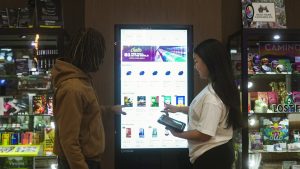
These are not just screens; they are interactive touchpoints that engage customers when your staff is busy elsewhere.
Imagine a customer standing in front of a luxury handbag.
A smart display nearby senses their presence and immediately shows a video of that bag being used in a lifestyle setting.
This immediate engagement creates a sense of immersion that traditional signage simply cannot match.
Interactive Product Discovery
Smart displays allow customers to explore your catalog without feeling pressured by sales staff.
They can check availability, compare different colors, or read detailed reviews on a high-definition screen.
This autonomy often leads to higher conversion rates because it reduces friction in the buying process.
Personalized Promotions
By integrating IoT with smart displays, you can offer hyper-personalized deals.
If a sensor detects a customer browsing a specific category, the display can show a limited-time discount for that exact item.
This creates a sense of urgency and makes the customer feel seen and valued.
Automation: Streamlining Operations for Increased Efficiency
While customer-facing tech gets the glory, backend automation is where you truly start unlocking profit retail operations.
Efficiency is often found in the tasks that no one sees.
Automation removes the human error and the high labor costs associated with repetitive manual tasks.
Consider the traditional method of inventory management.
An employee must walk the aisles, scan barcodes, and manually update a spreadsheet.
This is slow, expensive, and prone to mistakes.
IoT-enabled smart shelves can do this automatically by detecting weight changes or using RFID tags.
Inventory and Stock Management
Automated inventory systems alert you the moment a product hits a minimum threshold.
This prevents the dreaded “out-of-stock” scenario that drives customers to your competitors.
You can optimize your supply chain by predicting when stock will run low based on historical sales patterns.
Automated Staffing and Scheduling
IoT data can also help you manage your most expensive resource: people.
By analyzing foot traffic patterns through motion sensors, you can predict your busiest hours with high accuracy.
This allows you to schedule staff more effectively, ensuring you have enough coverage during rushes without overstaffing during quiet periods.
Measuring the ROI of Retail IoT Investments
Investing in new technology requires a clear understanding of the potential return.
You cannot simply buy gadgets and hope for the best.
You must track specific metrics to ensure your digital transformation is actually unlocking profit retail goals.
First, look at labor efficiency.
If automation reduces the hours spent on manual inventory by 50%, that is a direct saving.
Next, look at conversion rates.
Are customers who interact with smart displays spending more than those who do not?
Key Performance Indicators (KPIs)
To measure success, focus on these vital metrics:
- Sales per Square Foot: Is your tech helping you sell more from the same space?
- Inventory Turnover Ratio: Are you moving products faster thanks to better visibility?
- Customer Engagement Rate: How many people are interacting with your smart displays?
- Shrinkage Rates: Has IoT helped reduce theft or administrative errors?

Calculating the Payback Period
The payback period is the time it takes for the savings and increased revenue to cover the initial cost of the IoT setup.
While the upfront cost of smart displays and sensors can be high, the long-term reduction in operational friction usually leads to a rapid payback period.
Case Studies: Success Stories in Retail IoT Implementation
Theory is great, but real-world application proves the value.
Let’s look at how industry leaders have utilized these tools.
One major fashion retailer implemented smart mirrors in their fitting rooms.
These mirrors allowed customers to request different sizes via a touchscreen without leaving the room.
The retailer reported a significant increase in sales because the friction of finding a different size was removed.
Another grocery chain used weight sensors on shelves to automate restocking.
By knowing exactly when milk or bread was low, they reduced “out-of-stock” occurrences by a massive margin.
This led to higher customer satisfaction and a measurable boost in daily revenue.
Small Business Success
Even small boutiques are seeing the benefits.
A local boutique used a small smart display to show “complete the look” suggestions.
By showing how a scarf matches a specific jacket, they increased their average transaction value by nearly 15%.
Challenges and Considerations for Retailers
No technology deployment is without its hurdles.
As you begin unlocking profit retail through IoT, you must be prepared to face a few common challenges.
Data security is the most critical concern.
When you connect your store to the internet, you create new entry points for potential cyber threats.
Protecting customer data and your proprietary sales information must be your top priority.
Integration and Interoperability
You don’t want a store full of “silos” where your smart displays don’t talk to your inventory system.
Ensuring that all your hardware and software can communicate seamlessly is a major technical requirement.
Look for platforms that offer open APIs for better integration.
The Human Element
Technology should augment your staff, not replace them.
One of the biggest mistakes retailers make is failing to train employees on how to use these new tools.
If your team views the technology as a burden rather than a helper, they won’t use it to its full potential.

Future Trends in Retail IoT Technology
The landscape is constantly evolving.
We are moving toward a future where the “Phygital” experience—the blend of physical and digital—is seamless.
Artificial Intelligence (AI) will play a massive role.
We are already seeing AI being used to analyze video feeds from IoT cameras to understand customer sentiment.
Imagine a store that changes its music and lighting automatically based on the mood of the crowd.
Augmented Reality (AR) Integration
AR is the next frontier for smart displays.
Instead of just seeing a video, customers might use their smartphones or AR glasses to see how a piece of furniture would look in their actual living room, all while standing in your showroom.
Autonomous In-Store Robots
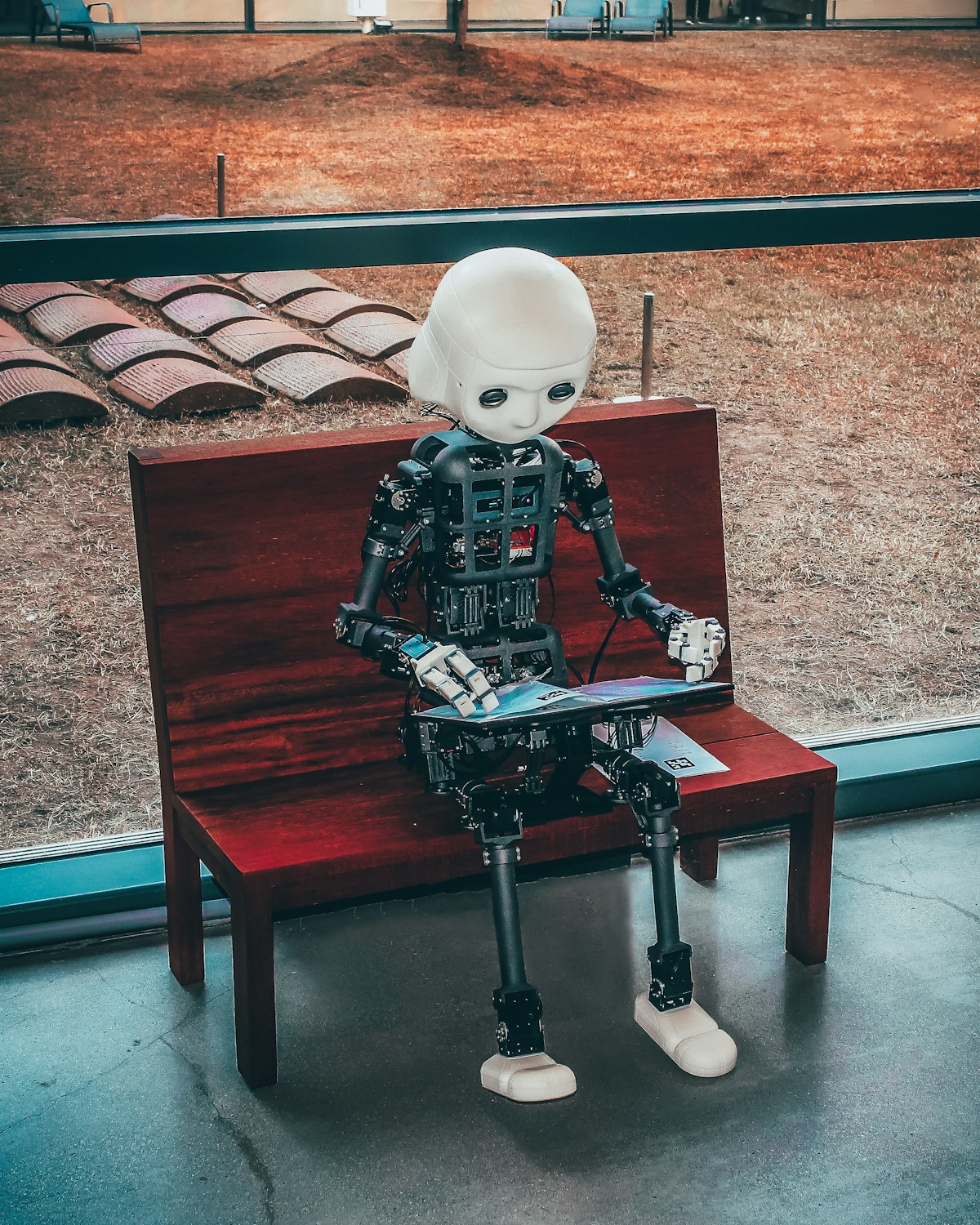
We are seeing the rise of small, autonomous robots that can navigate aisles to pick up orders for “buy online, pick up in store” (BOPIS) customers.
This further reduces labor costs and speeds up the fulfillment process.
By staying ahead of these trends, you ensure your business remains relevant.
The goal is not just to adopt technology for the sake of being modern, but to use it as a strategic tool for growth.
The journey toward unlocking profit retail success begins with a single step: understanding your data.
As IoT continues to mature, the gap between the leaders and the laggards will only widen.
Now is the time to evaluate your current tech stack and identify where automation and smart displays can provide the most immediate impact.
Ready to transform your store?
Start by auditing your current inventory processes and identifying one area where manual work is slowing you down.
The future of retail is smart, connected, and incredibly profitable.
Key Takeaways:
- IoT provides real-time visibility into inventory and customer behavior.
- Smart displays increase engagement and reduce friction in the buying process.
- Automation drives efficiency by reducing manual labor and errors.
- Data-driven decisions are essential for calculating true ROI.
- Security and integration are the two most important technical considerations.